Winblast Srl
Via Roma, 181
I - 26020 SPINADESCO (CR)
Phone +39 0372 173 0267 - E Mail : info@winblast.it
© 2023 Winblast Srl - All rights reserved - VAT number 01730190194

Corrective maintenance
When we talk about corrective maintenance, or breakdown maintenance, it is already too late. Yet there are cases in which it may be more appropriate to adopt corrective maintenance policies, especially if carefully managed and alternated with other types of maintenance.
Let's find out how together.
What is corrective maintenance
Corrective maintenance, also known as breakdown maintenance or in English run-to-failure, is a type of reactive maintenance. It is also the simplest and most outdated mode of asset management, which consists of intervening on a plant or machine only after a failure has occurred.
This type of maintenance is especially effective on non-critical and easy-to-repair systems at low cost, that is, when it is more convenient to wait for a failure before intervening, since the reduction in machine downtime, plant availability times, and production efficiency achievable with other maintenance methods do not provide benefits sufficient to justify the higher cost of adopting a more sophisticated strategy such as a preventive maintenance plan.
It therefore involves identifying the component on which a failure has occurred and replacing or repairing it in order to restore the proper functioning of the machine or plant.
Corrective maintenance definition
To give a more precise definition of what is meant by the term corrective maintenance, we can therefore say that it represents the set of maintenance actions that do not contribute to increasing the value, productivity, or performance of a system, but rather aim at simply restoring the status quo prior to the occurrence of a fault or breakdown.
Breakdown maintenance and corrective maintenance
As mentioned earlier, the two terms – corrective maintenance and breakdown maintenance – refer to the same type of maintenance action. Just like corrective maintenance, breakdown maintenance refers to those types of maintenance interventions in which the repair of a component or system is carried out only after a failure has occurred. These are therefore all those activities that are necessary to restore the original functions of the system in the event of a problem. The purpose of the intervention is to remove the problem that prevents operation, to restore wear and tear, without making any technical improvements.
Difference between preventive and corrective maintenance
Preventive and corrective maintenance are the two main maintenance policies, so it may be useful to take a moment to analyze the differences between the two.
As we have just said, corrective maintenance is the most antiquated type of maintenance, in the sense that it is the first maintenance policy to have been historically implemented within companies. We have just explained what it consists of.
Preventive maintenance, or scheduled maintenance, on the other hand, represents an evolution of corrective maintenance, due to the growing importance of preventing a breakdown to avoid significant repercussions on production levels caused by the occurrence of an unexpected machine stoppage. Preventive maintenance, in fact, through regular inspections, cleaning interventions, and other activities, has the ultimate goal of extending the asset lifecycle and minimizing the number of unplanned stops.
The difference between the two types of maintenance lies precisely in the moment when the intervention is carried out and the ultimate goal it aims to achieve: preventive (or scheduled) maintenance anticipates the failure with the aim of improving the performance and production of a plant, while breakdown maintenance intervenes when it is already too late and aims to restore the operating conditions of the machinery.
Benefits of corrective maintenance
In general, we can say that other maintenance policies are generally preferable to corrective maintenance, such as preventive and scheduled maintenance; however, it would not be correct to demonize breakdown maintenance regardless. As we have already partly seen, in fact, there are also advantages to adopting this type of strategy.
Very often, in fact, the winning strategy turns out to be a mix between the two policies of preventive and corrective maintenance, as can be seen from the graph below.
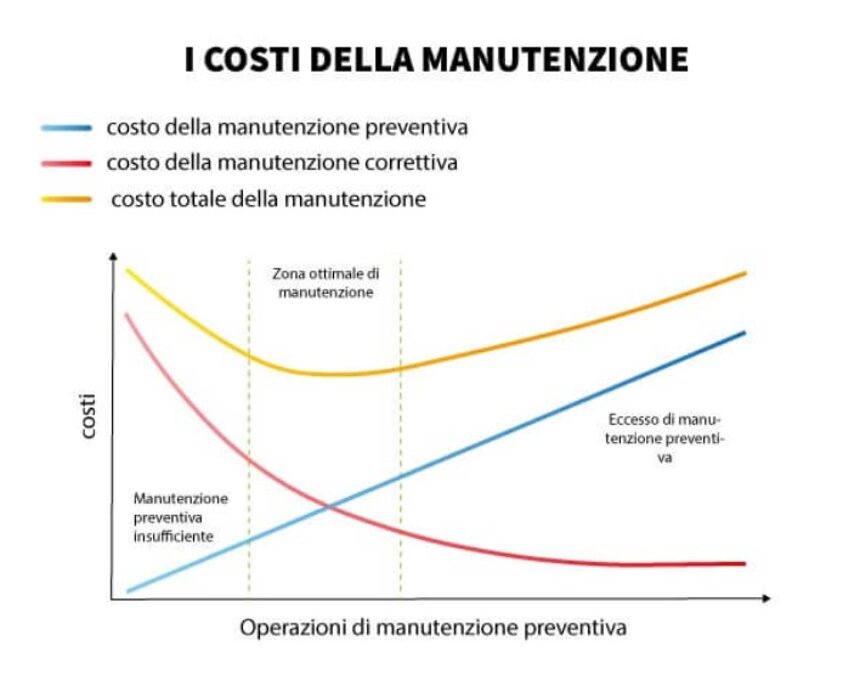
The graph shows the trend of total maintenance costs, divided into preventive and corrective maintenance, and as a function of the level of company maintenance. It is clear that in order to achieve cost efficiency in maintenance, it is advisable to find the right balance between the two strategies.
But what, specifically, are the benefits of adopting corrective maintenance strategies?
Very often, breakdown maintenance is referred to as a non-strategy, yet this is not always the case. Corrective maintenance can still be considered the winning choice when applied to non-critical and low-cost machinery, as it is a type of reactive maintenance that allows for considerable savings in terms of time and resources thanks to lower organizational complexity (we will analyze the disadvantages of applying this strategy in the following paragraph).
Here, then, are the main benefits of breakdown maintenance:
Breakdown maintenance can generate savings by eliminating the impact that preventive maintenance, inspections, and cleaning interventions can have on the budget.
For some classes of materials and for certain processes, in fact, it can be the most suitable and effective strategy, while it is certainly a risky and wrong choice when it involves complex and expensive machinery.
In addition, there are obviously also safety implications. Before deciding which maintenance strategy to adopt, it is advisable to carefully assess the risks and effects that a breakdown of a plant or machine could have on the process and on employee safety. A good way to assess these risks is to carry out an FMEA analysis.
This is why, as mentioned above, it is advisable to implement a mix of different maintenance policies, integrating a corrective maintenance strategy within preventive maintenance plans, finding the right balance between cost efficiency and production levels. In this way, we will also be sure to allocate available resources in the best way, focusing them on the machinery that needs them most.
Cost containment Strengthening production (when properly applied)
Disadvantages of corrective maintenance
The most questionable aspects associated with breakdown maintenance are certainly numerous:
Greater exposure of the machinery or plant to sudden and unexpected machine stoppages
A serious failure of a component can have negative consequences on other elements of the system, ultimately compromising its functionality. This can easily lead to a significant increase in costs. Furthermore, it is worth noting that it is often difficult, if not impossible, to detect a failure in an internal component of a plant unless it is frequently inspected. This increases the risk of further damage extending to other components of the same machinery, with consequences that can be catastrophic.
Sudden repairs that have not been scheduled often result in longer times to restore the machinery, further hindering production.
The allocation of personnel is an important aspect to consider. Sudden failures can catch us unprepared, causing further delays and inefficiency in the allocation of our resources.
Since these are unexpected failures, the spare parts warehouse will necessarily have to be oversized compared to actual needs, in order to guarantee the immediacy of the breakdown intervention.
Application of corrective maintenance
Breakdown maintenance is applicable to all those assets that fall into the following categories:
Non-essential assets: these are assets that can be easily replaced and swapped out once a failure occurs, without compromising or blocking the operation of the plant or machinery on which they are installed.
Short lifecycle assets: These are all assets that are not designed to last over time.
Disposable assets: These are all types of assets that are generally inexpensive and designed for single use. Some examples can be car tires or cartridges and toner for printers.
Low capitalization assets
Corrective software maintenance
Just as with preventive maintenance, a CMMS software can also be of great help in managing corrective maintenance operations and assets that are not considered important enough to warrant preventive interventions.
There are many ways and functions through which a CMMS software assists us. Starting with the management of intervention requests and work orders, which help to expedite interventions that usually need to be carried out as quickly as possible to avoid losses and inefficiencies.
In addition, a maintenance management software essentially creates a digital copy of our assets, automating the entry of data related to them. This, combined with their processing and the creation of an always up-to-date history, becomes indispensable when deciding to adopt a hybrid between preventive and corrective maintenance policies. The analysis of this data, provided through complete and customized reports, enables us to make more informed and conscious decisions when developing or reviewing a strategy, helping us find the right trade-off between the two.
Conclusions: key aspects to consider when applying a breakdown maintenance policy
In light of what has been said so far, we can summarize everything by highlighting some of the key aspects to consider when developing a corrective maintenance plan.
For certain classes of materials and processes, a corrective maintenance policy can represent a winning strategic choice. Choosing a breakdown maintenance strategy is always a risky choice. But it can be completely wrong when it involves complex and very expensive machinery and plants, exposing them to the real risk of unexpected downtime, unplanned productivity losses, and high maintenance costs. If properly integrated with a preventive maintenance plan, it may not generate negative effects on production cycles, make maintenance operations faster, and help with better allocation of available resources. A CMMS software can be a fundamental support when deciding to implement a breakdown maintenance plan, thanks to its features that allow interventions in emergency conditions to be more precise and efficient, as well as acquiring data and generating customized reports that can prove strategic when we want to assess the effectiveness of our choices.
Winblast Srl
Via Roma, 181
I - 26020 SPINADESCO (CR)
Phone +39 0372 173 0267 - E Mail : info@winblast.it
© 2023 Winblast Srl - All rights reserved - VAT number 01730190194