If you have any questions or encounter a problem, our team is available to help you. Send a request and we will respond as soon as possible.
Do you need assistance?
Winblast Srl
Via Roma, 181
I - 26020 SPINADESCO (CR)
Phone +39 0372 173 0267 - E Mail : info@winblast.it
© 2023 Winblast Srl - All rights reserved - VAT number 01730190194

Dust test kit
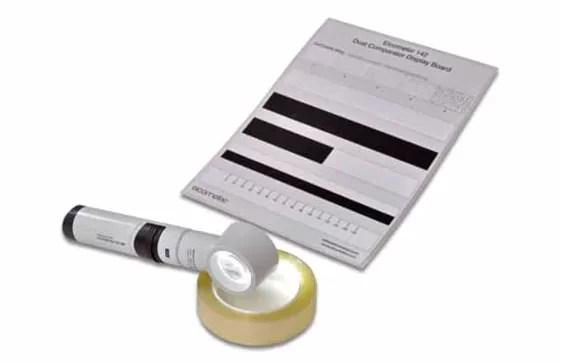
Analyze and measure the quantity and size of dust particles on sandblasted or shot-blasted components
Pay very close attention to metal surfaces during cleaning to ensure they are spotless before being painted or treated. The dust test kit allows you to detect residual particles that could prevent adequate corrosion protection.
This tool, based on ISO 8502 standard, can provide an accurate estimate of the levels of metallic dust presence. Winblast experts can help you find and use solutions to eliminate such particles.
Why check for dust on shot-blasted steel components?
The onset of rust is not solely due to low-quality paint or rough surfaces that have not been properly pre-treated. Dust particles, some of which can be quite large (often > 100 µm), can trigger corrosion.
The dust test kit helps to detect such particles and provides valuable information about the shot-blasting process as well as secondary issues such as cross-contamination from adjacent activities.
How to use the dust kit
The ISO 8501-1 standard classifies materials into four categories: A, B, C, and D depending on the visible oxidation before blasting. Classes A, B, and C are analyzed with the dust test kit at the end of the blasting process. Class D, on the other hand, is so corroded that the usefulness of this tool remains limited.
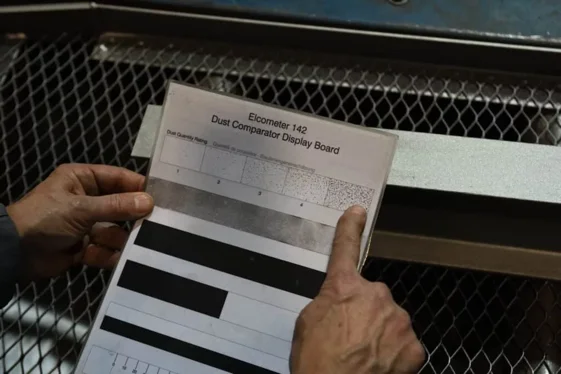
The dust test kit uses a special adhesive called Elcometer 142, which our Winblast experts apply to the analyzed surface. Then the Elcometer 145 or the Dust Tape Roller is used to apply three series of constant force of 4 or 5 kg on the adhesive thanks to the regular calibration of the instrument.
How to use
Assessment of the quantity of dust and particle size
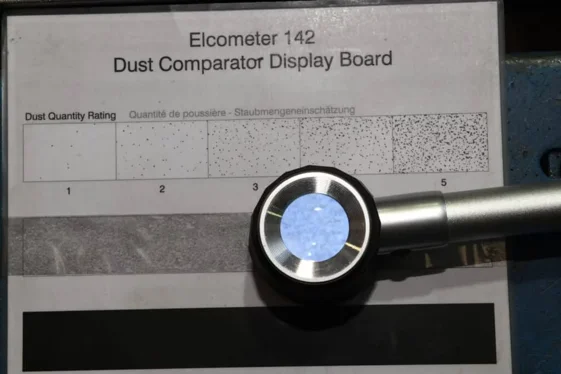
After removing the adhesive tape from the metal structure, it is applied to a new sheet from the dust test kit. The sheets include light and dark plates for better observation of the particles. A x10 magnifying glass is used to study the samples.
The first phase consists of assessing the amount of dust retained by the adhesive tape compared to the reference amount indicated on the dust test kit.
This measurement is classified into five classes, the first of which contains a low number of particles and the fifth a very high number. The granulometric classes are assigned according to the most similar size.
Next, the average particle size is assessed. A x10 magnifying glass is used to compare it with the other six reference classes. Class 0 indicates invisible particles while class 5 includes particles larger than 2.5 mm. The corresponding number is recorded on our model sheet.
Measurements to be implemented based on the results
Classes 3, 4, and 5 may require the rapid implementation of measures. Such measures may include adjusting the sandblaster suction system, using a more suitable spherical grit, monitoring hot spots, or even separating the sandblasting laboratory from the rest of the factory to reduce dust and its effects.
Winblast Srl
Via Roma, 181
I - 26020 SPINADESCO (CR)
Phone +39 0372 173 0267 - E Mail : info@winblast.it
© 2023 Winblast Srl - All rights reserved - VAT number 01730190194