If you have any questions or encounter a problem, our team is available to help you. Send a request and we will respond as soon as possible.
Do you need assistance?
Winblast Srl
Via Roma, 181
I - 26020 SPINADESCO (CR)
Phone +39 0372 173 0267 - E Mail : info@winblast.it
© 2023 Winblast Srl - All rights reserved - VAT number 01730190194


Plant maintenance: what it is and how to plan it
Industrial maintenance represents one of the most complex and strategic areas in the management of production plants. Plants and industrial machinery are in fact complex and highly technological systems, in which an unexpected machine stoppage or an unforeseen breakdown can have significant consequences, both on the company's turnover and on operational safety.
For this reason, in maintenance management nothing can be left to chance.
When we talk about maintenance of production plants, the main objectives guiding every activity are two:
increase the reliability of the plants, reducing the number of breakdowns and unexpected machine stoppages;
maximize productivity, increasing the time machines are actually operational and reducing downtime, unscheduled interventions, and production losses.
In the industrial context, the goal has always been to produce more while reducing operating costs. For a long time, however, maintenance was considered only as an unavoidable cost.
In reality, effective maintenance management can become an important factor in improving company performance. Through a proactive and data-driven approach, it is possible to reduce breakdowns, improve plant efficiency, and optimize production processes.
It is enough to compare the costs of a scheduled intervention with those of an unexpected machine stoppage to understand how much an effective maintenance strategy can make a difference.
However, it is also essential to consider another aspect: while maintenance increases the reliability and performance of plants, on the other hand it inevitably leads to an increase in operating costs.
The goal of industrial maintenance is therefore to find the right balance between costs and benefits, adopting strategies and intervention plans that allow you to reduce risks, improve productivity, and make the best use of available resources.
To be truly effective and meet the company's production needs and objectives, industrial maintenance must be able to:
plan operations, coordinating preventive maintenance activities with times when production is already stopped;
schedule interventions, providing technicians with all the necessary information to operate quickly and efficiently;
analyze data and optimize maintenance plans, adapting them to the real conditions of the plants, verifying their effectiveness, and reducing waste and inefficiencies.
This proactive approach leads to a new management paradigm, in which industrial maintenance takes on a strategic role, on par with production.
To achieve maximum performance from available resources, maintenance and production must operate in an integrated way, working together to improve the overall efficiency of the production system.
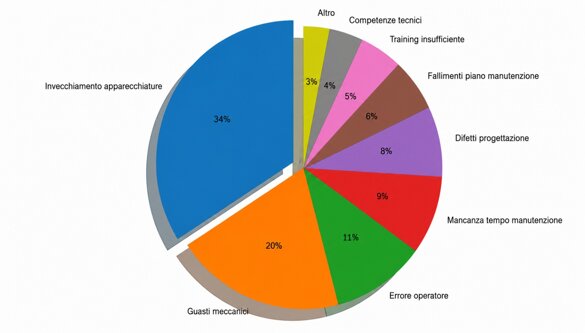
Main causes of unplanned machine downtime
The main industrial maintenance policies
There is no universally superior maintenance policy: each strategy has its own merit and is applied according to the context, the characteristics of the plant, and company objectives.
Below is a brief overview of the main maintenance policies for industrial plants.
Breakdown maintenance
This is the most basic form of industrial maintenance and involves intervening only after an anomaly or breakdown has occurred.
For this reason, breakdown maintenance can be an acceptable choice in certain situations, especially when the failure does not compromise production continuity or does not entail particular criticalities.
The main advantage of this policy is that it does not require scheduled plant shutdowns for inspections or preventive interventions.
On the other hand, when a breakdown occurs, it is necessary to shut down the plant to carry out the repair, with possible negative impacts on costs, time, and productivity.
Scheduled check-up
The goal of the scheduled check-up is to avoid breakdowns or, at least, to contain their effects. This strategy therefore involves intervening before an anomaly occurs, according to established preventive maintenance cycles, for example every 3, 6, or 12 months.
This is a useful approach to improve plant reliability and reduce the likelihood of unexpected shutdowns, provided that the planning is consistent with the actual use of the machines and their operating conditions.
Revamping
Revamping consists of a series of improvement interventions on the industrial plant, aimed at increasing its reliability, maintainability, and, in many cases, also its overall performance.
It may include technical modifications, component upgrades, structural improvements, or design solutions intended to reduce the plant's critical points and simplify maintenance activities.
Predictive maintenance
Predictive maintenance uses sensors and monitoring systems to check the condition of machinery in real time. In this way, it is possible to intervene only when the detected parameters indicate imminent wear or a concrete risk of failure.
This approach makes it possible to move beyond the logic of fixed-interval maintenance, intervening based on the actual condition of the plant and thus improving the overall efficiency of the maintenance plan.
A strategic approach to maintenance
Although in many cases a preventive or predictive approach allows for improved reliability and availability of plants, helping to reduce costs related to unexpected shutdowns and emergency interventions, to achieve concrete results it is necessary to adopt a more strategic view of maintenance.
This means adapting maintenance plans to the characteristics of individual plants, constantly evaluating their effectiveness over time, and integrating the maintenance function with production objectives.
Only in this way does maintenance stop being considered a mere cost and become a true tool for competitiveness, operational continuity, and improvement of company performance.
Winblast Srl
Via Roma, 181
I - 26020 SPINADESCO (CR)
Phone +39 0372 173 0267 - E Mail : info@winblast.it
© 2023 Winblast Srl - All rights reserved - VAT No. 01730190194